 DE
DE  EN
EN 

‘High-performance resins reduce salt consumption in water softeners by up to 33%. Learn more about efficiency potential through innovative ion exchangers.’
Innovative ion exchange resins enable significant savings in salt consumption in water softening systems. The following article shows the structure, functionality and savings potential of modern resin technologies.
1. Basics of ion exchange
Water is softened by exchanging the hardness minerals calcium and magnesium for sodium ions. This is done using special resins, which are loaded during operation and then regenerated with sodium chloride solution (DIN EN 973).
2. Importance of resin quality
The effectiveness of the process depends heavily on the salt consumption per litre of resin. Monosphere resins with a homogeneous grain size significantly improve the utilisation of the brine.
3. Comparison: standard resin vs. high-performance resin
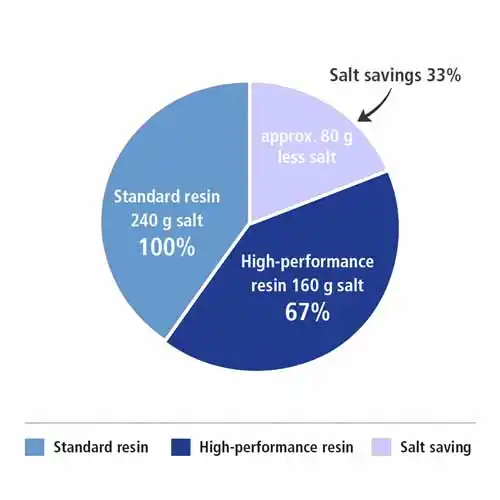
- Standard resin: ≤ 240 g salt/l resin
- High-performance resin: ≤ 160 g salt/l resin
- Salt savings: approx. 33%
4. Service life and maintenance
Due to mechanical stress (e.g. pressure, friction), the average service life of ion exchange resins is around six years. Replacing the resin requires adjustments to the system control and should only be carried out by trained specialists.
5. Practical examples of salt consumption
| No. | Flow rate (m³/h) | Standard resin (kg) | High-performance resin (kg) | Salt saving |
|---|---|---|---|---|
| 1 | 1.4 | 5.0 | 3.3 | 1.7 kg (approx. 34%) |
| 2 | 6.0 | 22.0 | 14.7 | 7.3 kg (approx. 33 %) |
6. Cost-effectiveness and areas of application
The actual savings depend on the size of the system, its operating time and the cost of salt. The conversion makes economic sense, especially in larger waterworks, swimming pools or industrial facilities.
7. Conclusion
Modern high-performance resins improve the efficiency of water softening systems and significantly reduce regeneration salt consumption. This saves operating costs and conserves resources. However, professional design and installation are essential for optimal implementation.